Karuma Bridge Closure to All Traffic for Major Refurbishment Works.

By Amos Ssemuwemba
The Minister of Works and Transport, Gen. Edward Katumba Wamala, has announced the full closure of Karuma Bridge to all traffic starting Monday, September 23, to allow for major refurbishment works. The bridge, which serves as a key link to northern Uganda, West Nile, and neighboring countries, had previously been partially closed to buses and trailers in May due to structural concerns.
“The contractor will immediately start the demolition of the concrete deck to allow major works for its restoration,” the Uganda National Roads Authority (UNRA) revealed in a statement, signaling the beginning of the long-awaited repairs. UNRA spokesperson Allan Ssempebwa confirmed that the refurbishment is expected to last three months.
Mr. Ssempebwa also provided details of the alternative routes that motorists will be required to use during the closure. For those traveling from Kampala to Gulu or West Nile, the recommended route will be through Luweero—Kafu—Masindi—Paraa (Murchison Falls National Park), connecting to Pakwach or Gulu via Olwiyo. Motorists heading to Lira are advised to use the Rwenkunye—Apac route via Masindi Port Ferry. An alternative route for Lira travelers is Iganga—Nakalama—Tirinyi—Pallisa—Kumi—Soroti—Lira.
The closure comes after a partial restriction was imposed on May 6, when engineers identified critical defects on the 61-year-old bridge, which required immediate attention. At that time, only passenger vehicles carrying up to 28 people were allowed to cross, with larger vehicles redirected to other routes.
The Karuma Falls Bridge, constructed in 1963, has served as a vital link for traffic connecting Kampala to northern Uganda, West Nile, DR Congo, and South Sudan. However, the narrow single-carriageway bridge, lacking pedestrian or bicycle lanes, has been prone to accidents and in need of significant repair.
Concerns had been raised by conservationists over the diversion of traffic through Murchison Falls National Park, one of Uganda’s largest wildlife reserves. “We were worried that the huge traffic would scare wildlife,” noted a conservationist. However, UNRA assured the public that the alternative route, spanning about 20 kilometers through the park, is fully paved and designed to minimize the impact on wildlife movement and behavior.
Mr. Ssempebwa further explained, “This is intended to protect and conserve Uganda’s rich wildlife heritage by significantly cutting down on the inconvenience, distress, and disturbance to wildlife.”
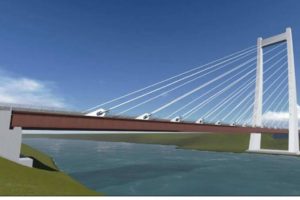
While the current restoration works aim to preserve the bridge for now, long-term plans are in place for the construction of a cable bridge, similar to the New River Nile Bridge in Jinja City, to replace the aging Karuma Bridge. However, Mr. Ssempebwa acknowledged that this remains a future ambition, with the focus currently on restoring the existing infrastructure.
The bridge closure is expected to impact thousands of travelers and goods heading to the northern and western regions, but officials are hopeful that the refurbished bridge will enhance safety and functionality in the near future.