


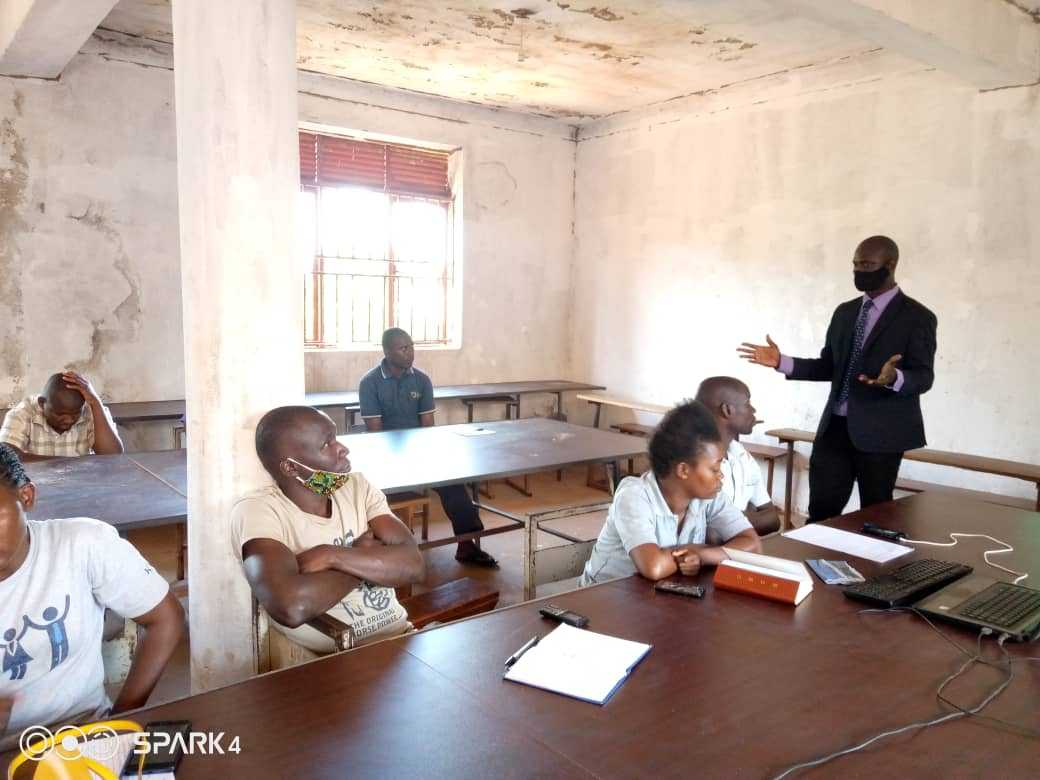
Edify Uganda a non-profit Christian NGO has started regional trainings of teachers in the use of appropriate technologies in education. The trainings come at a time when millions of students are inevitably out of school due to measures put in place to curb the spread of the novel corona virus.
The programme that was initiated by the Edify Country Director, Godfrey Lugoloobi will benefit over 100 schools from the districts of Luwero, Kampala, Wakiso, Jinja and Gulu. This is in line with Edify’s mission “To improve and expand sustainable Christ centered education.”
This 5 day training started on 14th September 2020 with 8 pilot schools some of which include Continental Whiteland College Busega and Shallom Primary School in Kampala, Jinja Parents School, Hope Community High School and St. James SS in Jinja and Father’s Children Nursery and Primary School in Kalagi. In the pilot phase that is fully funded by Edify, about 80 teachers of various disciplines are to benefit.


The project co-ordinator, Mr. Rogers Mukalele said that teachers would be trained in the use of internet tools for teachers, basic computer care and maintenance, creation of electronic presentations for digital lessons, use of online collaboration software and sharing of content on the kolibri platform. The skills acquired would then be used to create learning content that will be shared on the respective school websites whose hosting and building are also going to be paid for by Edify Uganda.
In the implementation of the edu-tech project, Edify Uganda partnered with the ICT Teachers’ Association of Uganda who provided the manpower to facilitate the 5 day training. Some of the facilitators included Mr. Moses Wejuli, Mr. George Emorut, Mr Charles Mudawa, Mr. Henry Sekitto, Mr. Mukisa Godfrey and Mr. Isaac Ogwal.
Selection of pilot schools was based on a survey that was conducted in August on the schools’ readiness to engage learners during the Covid-19 break. It was discovered that some of the staff in the over 100 schools had the will to conduct lessons remotely but lacked the necessary tools and skills to do so.
According to the Country Director, after the training, all partner schools will be provided with an online platform where teachers will upload lesson material for learners to access even when they are not physically at school. The online platform is being implemented with the involvement of Edify Uganda, ICT Teachers’ Association of Uganda and the National Association of Christian Schools in Uganda.
Mr. Godfrey Lugoloobi further revealed that Edify will help all partner schools reach a level where schools will be able to independently sustain the use of education technology to aid in teaching and learning. Currently, Edify Uganda has reached close to 700 schools, over 160,000 students, trained over 1,000 school leaders and teachers and disbursed over USD 320,000 worth of loans to select schools.
Mr. Emorut George, the lead facilitator at Continental Whiteland College in Kampala had this to say about the project.
I thank Edify for this great opportunity to upgrade the current generation of teachers in Uganda. This opportunity is engaging and inspiring most of the teachers who confess to be traditional teachers. It is also going to transform them to become digital teachers who can hold the teaching and learning process irrespective of distance between and with their learners.
With the uncertainty of opening of schools this year, it has become increasingly inevitable for teachers to graduate from traditional methods of teaching to the new normal that will involve handling of some lesson remotely. This will not only help during the lockdown but also help modify the teaching and learning experience to conform with modern methods of the 21st century.
Moses Wejuli, while training over 10 teachers at The Bright Day and Boarding School in Kampala was equally thankful for Edify’s intervention.
It is a timely opportunity especially in this period when many schools and teachers are finding a hard time getting in touch with their learners. This training will enable them acquire the necessary skills not for only this period but to adjust and quickly get adopted to the new trends in the education system.
This intervention which is to be implemented in over 100 schools will help learners to continue learning even when they are not physically in class and also give them the opportunity to learn from teachers from other schools.

